Feedback Loops
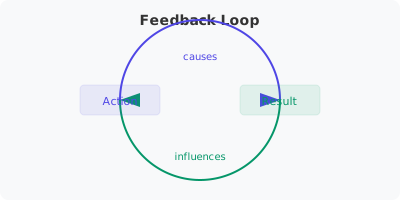
A feedback loop occurs when the output of a system circles back to influence its own input. Feedback loops are everywhere: in biology, economics, software, and social dynamics.
Types
- Positive (reinforcing) feedback loops amplify change. Success breeds confidence breeds more success. A bank run starts with a few worried depositors, which worries more depositors, which accelerates the run.
- Negative (balancing) feedback loops dampen change and push toward equilibrium. A thermostat detects heat above the set point and turns off the furnace.
Why They Matter
Understanding feedback loops helps you predict how systems will behave over time. Many Second Order Thinking effects are driven by feedback loops — the initial action triggers a chain reaction.
Connections
Margin of Safety accounts for the fact that positive feedback loops can spiral out of control faster than expected. Circle of Competence grows through negative feedback loops: try something, get feedback, adjust, repeat. And Map is Not the Territory reminds us that our models of feedback loops are themselves simplifications.
Alfred Korzybski understood this well — our abstractions of dynamic systems are always frozen snapshots of something that is constantly changing.