Notable Mental Models
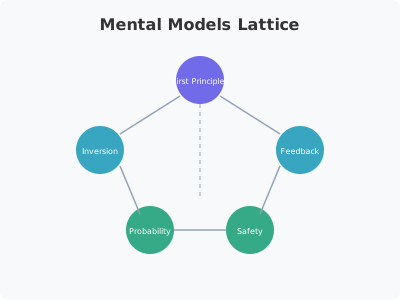
A mental model is a simplified representation of how something works. By collecting and mastering a broad set of mental models, you can think more clearly and make better decisions.
This site explores some of the most useful mental models across disciplines:
Core Thinking Tools
- First Principles Thinking — break problems down to their fundamental truths
- Inversion — think backwards from failure to find the path to success
- Second Order Thinking — consider the consequences of the consequences
- Probabilistic Thinking — embrace uncertainty and think in probabilities
Understanding Reality
- Circle of Competence — know the boundaries of what you truly understand
- Razors — practical heuristics for quick decision-making
- Occam's Razor — prefer the simplest explanation that fits the facts
- Hanlon's Razor — don't attribute to malice what ignorance can explain
Systems and Safety
- Margin of Safety — build buffers for the unexpected
People
- Charlie Munger — champion of the latticework of mental models
- Warren Buffett — master of circle of competence and long-term thinking
- Howard Marks — popularized second-level thinking in investing
For a broader overview, see Mental Models Overview.